Caramel popcorn production involves more than popping corn and adding sugar. To produce popcorn with a consistent caramel coating, manufacturers need to control popping quality, caramel preparation, mixing, cooling, and packaging. Each stage affects the final product's appearance, sweetness, texture, and shelf life.
For commercial snack brands and popcorn factories, the right equipment helps make production more consistent and reduces the need for repeated manual handling. XFD provides popcorn production and coating equipment designed for different production requirements, from compact operations to industrial manufacturing lines.
How Does Caramel Popcorn Production Work?
The basic caramel popcorn manufacturing process follows a clear sequence: prepare the kernels, pop the corn, cook the caramel, coat the popcorn, cool the finished product, and package it. Depending on the factory's output and product requirements, some stages can be integrated into an automated production line.
The main goal is to achieve an even coating without crushing the popcorn or leaving excessive caramel clumps. Stable processing conditions also help manufacturers reproduce the same flavor and texture across production batches.
Preparing Kernels for Consistent Popping
Good caramel popcorn starts with suitable popcorn kernels. Kernel variety, moisture content, storage conditions, and popping performance all influence the number of unpopped kernels and the shape of the finished popcorn.
Before production, manufacturers should check kernel quality and remove foreign materials where necessary. Consistent popping creates a more uniform base for caramel coating and helps reduce waste during subsequent processing.
For factories producing large volumes, an industrial popcorn production machine can help meet production demands while providing a suitable foundation for downstream flavoring and coating operations.
Popping the Corn Before Caramel Coating
During popping, heat causes moisture inside the kernel to expand until the kernel opens and forms popcorn. A stable heating process helps improve popping consistency and limits burnt kernels that could affect the flavor of the final product.
Manufacturers should also consider the shape and strength of the popped corn. Mushroom-style popcorn is often selected for coated products because its rounded shape can provide a useful surface for caramel coverage. The best kernel and popping setup will depend on the product specification and the equipment being used.
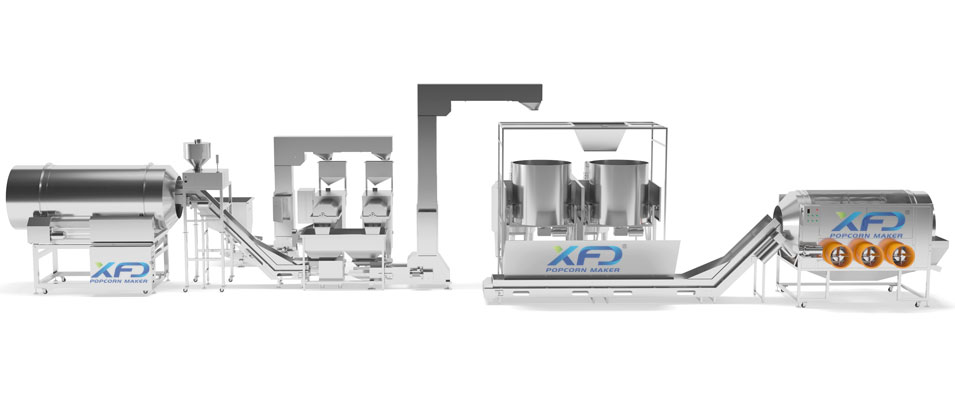
For higher-volume operations, XFD offers industrial hot-air popping and caramelizing equipment that combines popping and coating stages in a production-line configuration.
Cooking Caramel to the Right Consistency
Caramel preparation is one of the most important stages in caramel popcorn production. Sugar-based ingredients must be heated and mixed according to the recipe so that the caramel reaches a suitable consistency for coating. Temperature, cooking time, ingredient ratios, and moisture all influence how the caramel behaves.
If the caramel is too thick, it may not spread evenly across the popcorn. If it is too thin, the coating may remain sticky or take longer to set. Excessive heating can also darken the caramel and create a bitter, burnt flavor.
An industrial cooker and coater can help manufacturers control heating and mixing more consistently. XFD's industrial popcorn caramelizer features digital temperature control and an adjustable stirring system. The listed model has a capacity of 13 kg per kettle based on uncoated popcorn, making its specifications worth reviewing when planning a production setup.
Coating Popcorn with Caramel Evenly
Once the caramel is ready, it must be distributed across the popped corn. Proper coating depends on the caramel's flow characteristics, the amount added, mixing speed, batch size, and the design of the coating equipment.
Mixing needs to distribute caramel without breaking too many popcorn pieces or allowing the coating to gather in heavy clumps. Operators should follow the equipment manufacturer's recommendations and test the recipe under actual production conditions.
For manufacturers choosing dedicated equipment, XFD's popcorn coating machines cover coating and seasoning applications. For caramel-based products, a heated cooker and coater may be more appropriate than a non-heated tumbler designed mainly for powders and other dry flavorings.
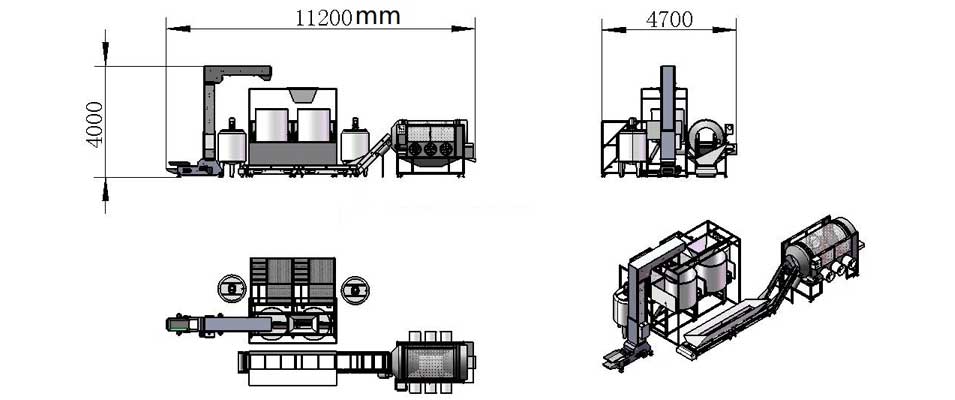
For integrated production, the industrial hot-air popcorn line with a coating drum and caramelizer combines key stages for factories seeking a coordinated process. XFD lists this line for high-capacity applications, with a stated output range of 180–250 kg/h for caramel or chocolate popcorn; actual suitability should be confirmed against the planned recipe and operating conditions.
Cooling Caramel Popcorn to Preserve Crispness
After coating, caramel popcorn needs sufficient cooling before it is packed. As the caramel cools, it sets around the popcorn. Packing the product too early can trap heat and moisture, increase condensation risk, and cause pieces to stick together.
Cooling conditions should be consistent with the recipe, product temperature, room humidity, and equipment design. The target is a stable coating and a crisp texture, not simply the shortest possible cooling time.
For production environments that need cooling and separation after coating, manufacturers can evaluate XFD's industrial popcorn processing equipment and discuss the appropriate downstream configuration with the supplier.
Packaging Caramel Popcorn for Storage and Distribution
Packaging is the final step in protecting caramel popcorn quality. Even a well-coated product can lose crispness if it absorbs moisture during storage or distribution. Manufacturers should select packaging materials and sealing methods based on the product's moisture sensitivity, target shelf life, distribution environment, and packaging format.
Before choosing a packing machine, consider the required output, bag size, portion accuracy, sealing performance, and how the packaging stage will connect with the rest of the line. A well-planned process reduces unnecessary handling between cooling and packing.
Factories planning a more integrated setup can explore XFD's industrial popcorn production solutions and confirm whether additional cooling, conveying, or packing equipment is needed for their workflow.
Common Problems in Caramel Popcorn Manufacturing
Uneven caramel coverage: Check the caramel consistency, mixing time, batch size, and coating method. Confirm that the equipment can distribute the recipe evenly without overloading the mixing chamber.
Sticky finished popcorn: Review caramel cooking conditions, cooling time, and humidity exposure. Moisture and an unsuitable coating formula can prevent the caramel from setting as expected.
Burnt or bitter flavor: Check the heating profile, temperature measurement, cooking time, and ingredient ratios. Avoid relying on visual color alone to judge caramel readiness.
Too many broken pieces: Review the condition of the popped corn, transfer points, mixing speed, and handling method. Excessive mechanical action can damage fragile popcorn.
Inconsistent production output: Compare the capacity of the popping, caramelizing, cooling, and packing stages. The actual line output is limited by the stage that cannot keep up with the others.
Choosing Equipment for a Caramel Popcorn Production Line
The right setup depends on how much popcorn a business needs to produce, whether it makes caramel popcorn exclusively or multiple flavors, and how much automation is required. Smaller operations may prioritize a compact combined machine, while larger factories may need separate popping, caramelizing, coating, cooling, and packaging stages.
When comparing equipment, evaluate hourly output, batch size, heating method, stirring adjustment, cleaning access, available floor space, power requirements, and the ability to expand capacity later. Confirm whether the supplier's stated capacity refers to uncoated popcorn, finished product, or another measurement basis.
XFD offers industrial popcorn production lines and dedicated caramelizing equipment for different manufacturing needs. Buyers should share their target output, recipe, factory conditions, and automation requirements to identify a suitable configuration.
Frequently Asked Questions About Caramel Popcorn Production
What are the main steps in caramel popcorn production?
The main steps are kernel preparation, popping, caramel cooking, coating, cooling, and packaging. The exact process depends on the recipe and production equipment.
Which machine is used to coat popcorn with caramel?
A heated popcorn cooker and coater or an industrial caramelizer is commonly used for caramel coating. The machine should provide suitable heating, mixing, and temperature control for the recipe.
Why does caramel popcorn become sticky?
Common causes include excess moisture, unsuitable caramel consistency, insufficient cooling, and humid storage conditions. Manufacturers should review both the cooking process and post-coating handling.
How can manufacturers achieve an even caramel coating?
Use a consistent caramel formula, maintain suitable cooking conditions, match batch size to equipment capacity, and adjust mixing according to the product. Test the finished popcorn before scaling up production.
What should a factory consider when choosing a caramel popcorn production line?
Important factors include target output, batch size, caramelizing capacity, coating uniformity, cooling requirements, automation, cleaning, and future expansion. Confirm the capacity basis and final configuration with the equipment supplier.
Can one production line make different popcorn flavors?
Some XFD production lines are designed to process multiple flavors, but the available recipes and changeover requirements depend on the specific equipment. Confirm cleaning procedures and compatibility before switching between products.
For help selecting equipment for your caramel popcorn manufacturing process, visit XFD's industrial popcorn machine range or contact the XFD team to discuss your production requirements.