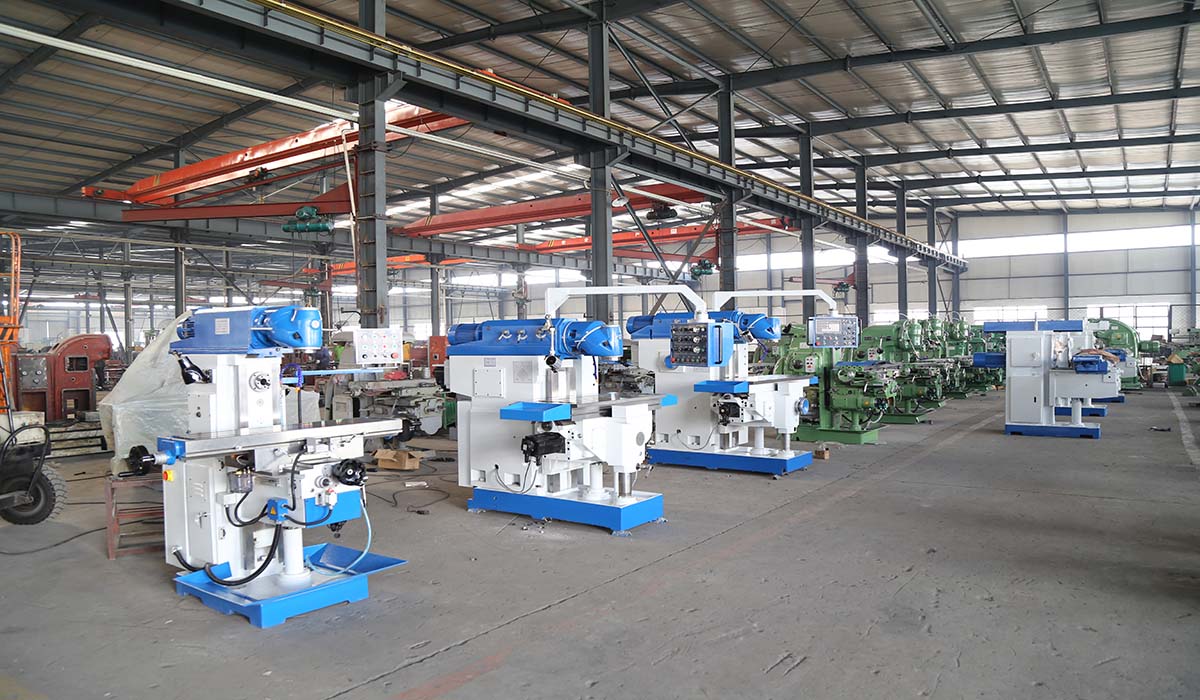
The bed, as the basic supporting framework of the milling machine, is mostly made of high-strength cast iron, featuring strong rigidity, good shock absorption, and low susceptibility to deformation. The bed supports all the components of the machine, such as the guide rails, the spindle box, and the lifting table, and absorbs the vibration during milling to prevent the equipment from shaking and affecting the machining accuracy of the workpiece. It is the core guarantee for the stability of the entire machine.
The spindle system, which is the core power output component of the milling machine, consists of the spindle, bearings, and transmission gears. The spindle drives the milling cutter to rotate at high speed, achieving the main cutting motion. The rotational accuracy and speed stability of the spindle directly determine the surface finish and dimensional accuracy of the workpiece. The layout of the spindle in vertical and horizontal milling machines is different. It can be adjusted in speed through a speed-changing mechanism to meet the cutting requirements of different materials and tools, such as steel and aluminum.
The worktable is the component for holding and feeding the workpiece. It is equipped with T-shaped grooves for fixing flat jaws, workholding fixtures, and workpiece blanks. The worktable can achieve manual or automatic longitudinal and lateral feed. Some vertical milling machines can be equipped with a lifting feed motion, precisely controlling the cutting position and feed amount of the workpiece, and the positioning accuracy directly affects the dimensional tolerance of the part.
The feed transmission mechanism includes components such as the feed gearbox, screw rod, lead screw, and feed motor, which provide stable feed power for the worktable. It can adjust the feed speed in multiple levels and is suitable for different processes such as rough milling with large cutting volume and fine milling with small feed volume. Precise feed transmission can avoid feed jamming and tool shifting problems, improving processing consistency.
The milling cutter and cutter holder components are the components that directly cut the workpiece. They are fixed and locked together with the cutter head, cutter handle, and chuck. Different types of milling cutters (such as end mills, face mills, and three-sided edge mills) are suitable for plane, groove, and keyway processing. The concentricity of the clamping components determines the smooth operation of the tool, preventing deflection and causing processing errors.
The speed control mechanism is controlled by a handle, a shift fork, and a gear set to achieve step-by-step adjustment of the spindle speed and feed speed. Operators can reasonably match cutting parameters according to the material of the workpiece, the material of the tool, and the processing procedure (rough milling / fine milling), taking into account both processing efficiency and tool lifespan.
The cooling and lubrication device consists of a cooling pump, a cooling fluid tank, a pipeline, and nozzles. During processing, it sprays cutting fluid to achieve cooling, lubrication of the tool, removal of iron filings, and rust prevention. It reduces tool wear, avoids workpiece thermal deformation, and improves the surface quality of the processing. The lubrication system is also equipped to supply oil to the guide rails, screw rods, and other moving parts, reducing mechanical wear and extending the service life of the machine.